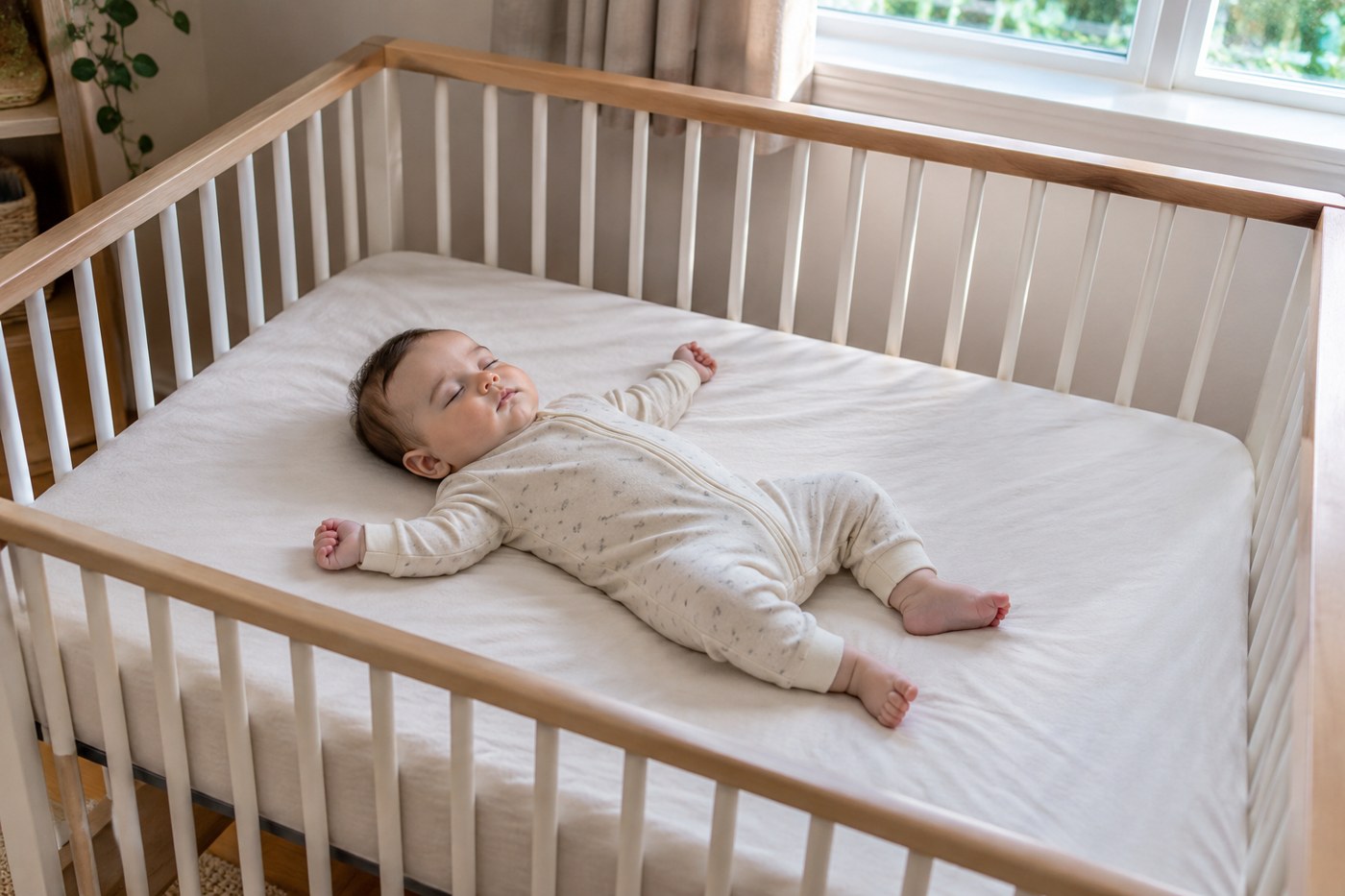
When nights get colder, many parents want to add one more layer, one more blanket, or turn the heating up "just in case." It comes from love. But research on baby sleep keeps pointing in the same direction: a baby who is a little cool is usually fine, while a baby who gets too hot during sleep is at higher risk. Here is what the science says and how to keep things simple at home.
What the research says about overheating
Overheating during sleep is a known risk factor for sudden infant death syndrome (SIDS). The American Academy of Pediatrics lists it among its safe-sleep recommendations, and the NHS and the Lullaby Trust give the same advice.
A 2022 narrative review in *Frontiers in Pediatrics* looked at decades of studies on heat stress and SIDS. The authors found that overheating in babies mainly comes from too much clothing and bedding insulation. They also suggest that heat can interfere with a baby's normal breathing and arousal, even when it is not directly dangerous on its own. It is a review of mostly observational research, so it cannot prove cause and effect. Still, it supports what health services already recommend: avoid over-wrapping, and keep the head and face uncovered.
Babies lose a lot of heat through their head and face. That is why head coverings during sleep get special attention.
The room: a cool, comfortable range
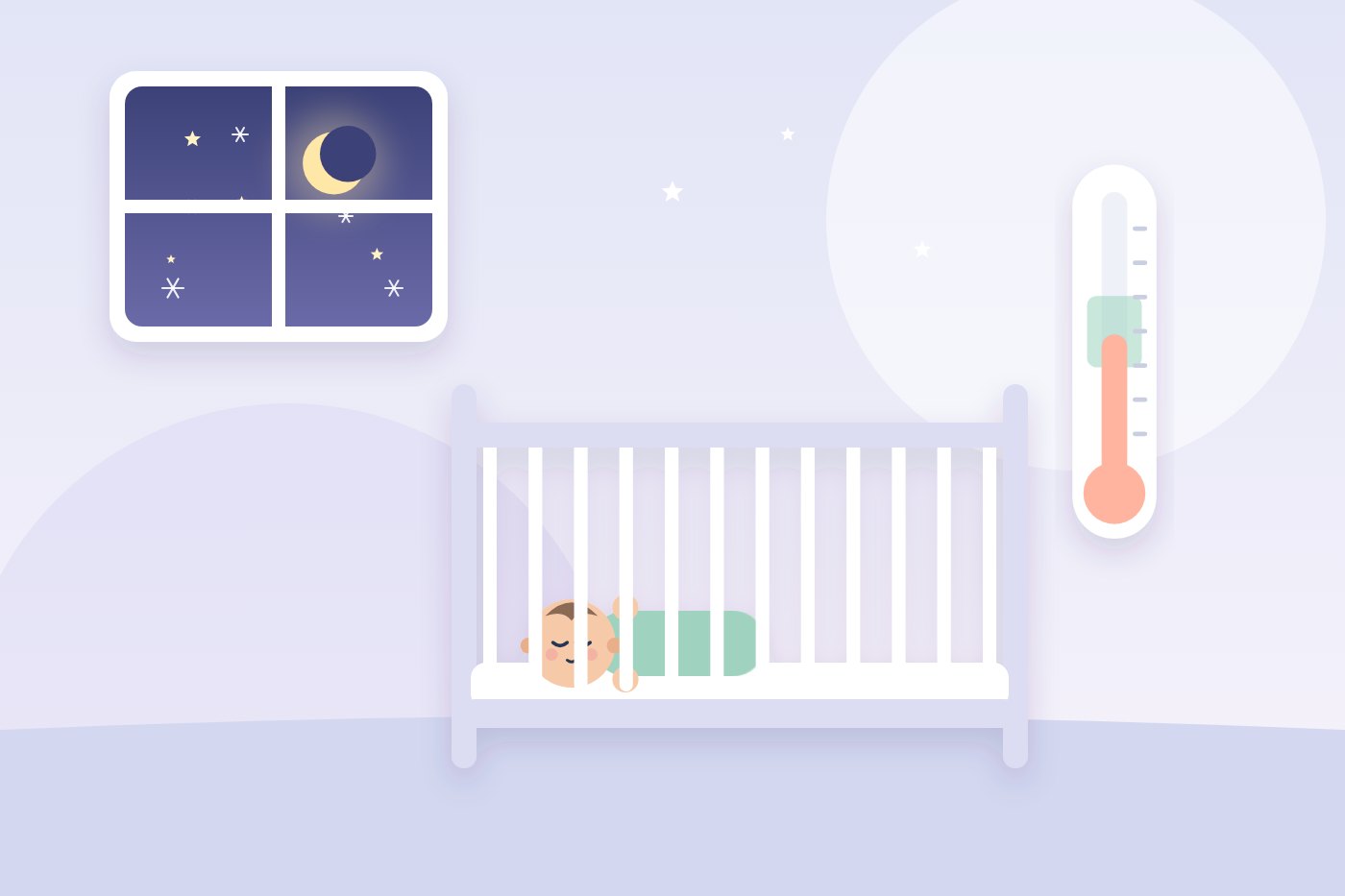
The NHS and the Lullaby Trust recommend a room temperature of about 16–20 °C (roughly 61–68 °F) for a sleeping baby. A few practical points:
- Use a simple room thermometer. Guessing the temperature is unreliable, especially in winter when heating switches on and off.
- Leaving the heating on all night is rarely necessary. If you do, set it low and no higher than 20 °C.
- Keep the crib away from radiators, heaters, fires and direct sunlight.
- Never use a hot water bottle or an electric blanket for a baby.
Not every home can hit an exact number, and that's OK. The range is a guide, not a test. What matters most is how your baby feels.
Dressing your baby for sleep
The AAP's rule of thumb: dress your baby in about **one layer more than you would wear** to be comfortable in the same room. In winter, the NHS says a sleepsuit plus a sleeping bag, or a sheet and lightweight blankets, is usually enough.
- **Sleep bags (wearable blankets)** help because they can't cover your baby's face. Choose one with a fitted neck and armholes and no hood, in the right size for your baby.
- **TOG** is a number on many sleep bags that describes how warm the fabric is. Higher TOG means warmer. Many manufacturers suggest about 2.5 TOG for a room of 16–20 °C, but products differ and every baby is different, so treat the label as a starting point, not a rule.
- If your baby seems cold in a sleep bag, add a clothing layer underneath rather than a blanket on top.
- If you use blankets, choose thin cellular ones, tuck them in firmly no higher than your baby's shoulders, and place your baby with their feet at the foot of the crib. Remember that a folded blanket counts as two layers.
- **No hats indoors**, and no hoods, beanies or bonnets for sleep. Take them off as soon as you come inside or get into a warm car.
- Don't use weighted sleep bags, weighted swaddles or weighted blankets.
- Stop swaddling as soon as your baby shows signs of trying to roll.
And always: baby on their back, on a firm, flat surface, with nothing loose in the crib.
How to check if your baby is too hot or too cold
Hands and feet are often cool, and that is normal. They don't tell you much.
Instead, feel your baby's **chest, tummy or the back of the neck**:
- Hot, sweaty or damp hair: remove a layer.
- Cool to the touch: add a light layer of clothing.
If you check during the night, a quick touch is enough. You don't need to wake your baby.
When your baby is unwell
It is tempting to wrap up a baby who has a cold or a fever. Health services advise the opposite: don't add extra clothing or bedding, keep the head uncovered, and dress your baby for the room. Fever is a reason to contact a health professional, not to bundle up.
A quick bedtime checklist
- Room roughly 16–20 °C (61–68 °F), checked with a thermometer.
- Sleepsuit plus a well-fitting sleep bag, or thin layers tucked in firmly.
- No hat, no hood, nothing covering the head or face.
- Crib away from radiators and heaters; no hot water bottles.
- Check the chest or the back of the neck, not the hands.
If you'd like to see whether small changes in the room affect your baby's nights, a sleep log can help. With BabyZleepy you can note sleep times and look for patterns over a few days.
When to talk to a professional
Contact your doctor, health visitor or local health service if your baby has a fever, seems unusually floppy or drowsy, is not feeding well, has fewer wet diapers, or you are worried for any reason. Signs such as trouble breathing, unusual skin color, or being very hard to wake need urgent medical help. Every baby is different, and you never need to wait for a "good reason" to ask.
General information, not medical advice. If you are worried about your baby's sleep, feeding or health, talk to your doctor, midwife or health visitor.
Sources
- The Lullaby Trust — Room temperature and baby sleep
- NHS Start for Life — How to dress a newborn
- American Academy of Pediatrics — How to Keep Your Sleeping Baby Safe
- Red Nose Australia — Bedding for safe sleeping
- Hyperthermia and Heat Stress as Risk Factors for Sudden Infant Death Syndrome: A Narrative Review (Frontiers in Pediatrics, 2022)